Light isn't just seen, it's also felt. Walk up a stair beside a wall glowing in one smooth band of light and you feel calm and settled. Walk up the same stair with scallops, dark gaps, and hot spots and something feels off, even if you can't say what.
On a recent project in River Oaks, the wall along the main stair landing was curved. That curve was the best feature of the space, and it was also the hardest part to light well.
What wall washing is supposed to do
Wall washing covers a wall in smooth, even light from top to bottom. Done right, it softens shadows, hides small imperfections in the finish, and makes the wall itself the light source you notice. On a flat wall, that usually comes down to a fixture with the right beam and a repeating spacing off the wall.
Why curved walls are tricky
A curve breaks that easy math. As the wall bends, each fixture's distance to the wall changes. Use the same spacing you'd use on a flat wall and some fixtures end up too close, throwing a bright scallop, while others sit too far back and leave a dim gap.
Worse, you usually don't see the problem until the lights are on. By then the ceiling is closed, the drywall is finished, and the fix means cutting, patching, and repainting.
How we studied it before install
This is what light studies are for. Before anything was installed, we modeled the stair wall and ran a lighting study. Because the distance to the wall changes along the curve, we placed each fixture one by one, then used a false-color map of light levels to adjust until the wall read as one even band.
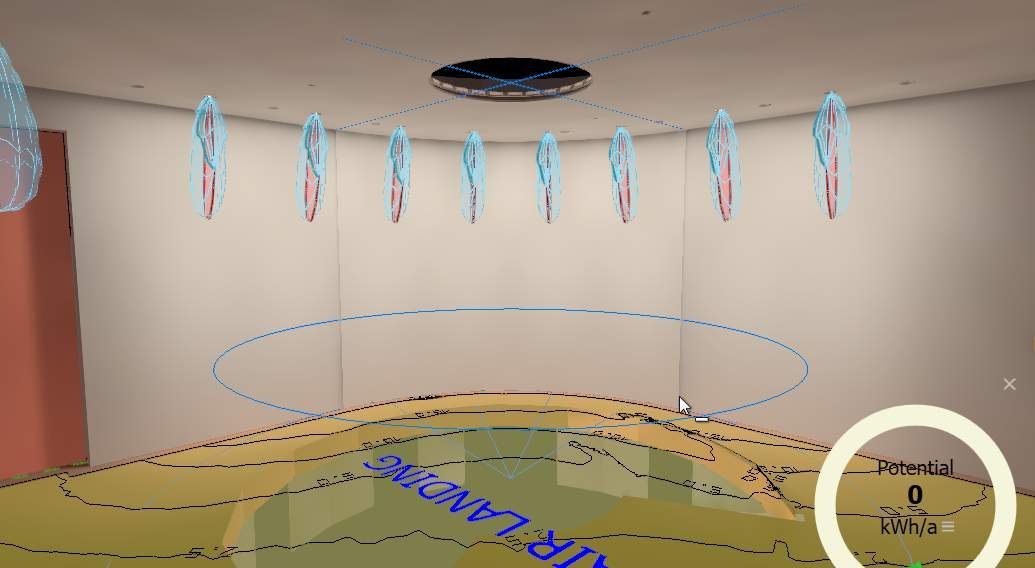
Fixture positions and beam spreads on the curved wall
Catching the framing early
The study did more than pick fixture spots. The framing didn't allow for the spacing the design required. Because we caught it before the drywall went up, we had the framer come back and reframe it. That was a much smaller ask than tearing into a finished ceiling later.
That's the real value of a light study for a builder or designer. It gives everyone the information to make decisions while changes are still cheap, and it gives us what we need to advocate for the adjustments that make the design work.
Why brand-neutral photometrics matter
Lighting reps often offer photometric studies for free. They can be useful, but they're built to show the fixtures that rep sells. We're brand-neutral and not tied to any manufacturer, so our studies start from what the wall and the room need, then find the fixture that does it.
Bring us in early
The finished result depends on what happens long before the lights turn on. If you're a builder, architect, or interior designer working on a home in River Oaks, Memorial, Tanglewood, or anywhere in Houston, bring us in while the plans are still on paper. A curved wall, a tall stair, an art wall, or a room that just needs to feel right: we'll study it before it's built.
Email Wynne at wynne@wynnewalkergroup.com to talk about your next project.